


Hey there! As a supplier of Magnesium II Nitrate, I often get asked about all sorts of things related to this compound. One question that pops up quite a bit is, "What is the boiling point of Magnesium II Nitrate?" Well, let's dive right into it.
First off, Magnesium II Nitrate, also known as magnesium nitrate, has the chemical formula Mg(NO₃)₂. It's a pretty interesting compound with a bunch of different uses. Before we get into the boiling point, let's talk a bit about what this stuff is and where you might find it.
Magnesium nitrate is commonly used in agriculture. It's a great source of both magnesium and nitrogen, two essential nutrients for plant growth. If you're into farming or gardening, you might want to check out Magnesium Nitrate Uses in Agriculture. It gives you a detailed look at how this compound can boost your crop yields and keep your plants healthy.
Another cool thing about magnesium nitrate is that it comes in different forms. One of the most common is magnesium nitrate hexahydrate flakes. These flakes are easy to handle and dissolve quickly, making them ideal for a variety of applications. You can learn more about them at Magnesium Nitrate Hexahydrate Flakes.
Now, back to the main question: what's the boiling point of Magnesium II Nitrate? Well, it's a bit tricky because magnesium nitrate doesn't really have a straightforward boiling point like some other substances. When you heat magnesium nitrate, it starts to decompose before it reaches a true boiling state.
At around 330°C (626°F), magnesium nitrate begins to break down into magnesium oxide (MgO), nitrogen dioxide (NO₂), and oxygen (O₂). The reaction looks something like this: 2Mg(NO₃)₂ → 2MgO + 4NO₂ + O₂. So, in a way, you could say that this decomposition temperature is the "end" of the line for magnesium nitrate as a stable compound.
The reason for this decomposition is due to the nature of the nitrate ions in the compound. Nitrates are pretty unstable at high temperatures, and they tend to break apart, releasing nitrogen and oxygen gases. This is why you won't find a traditional boiling point for magnesium nitrate in most chemistry textbooks.
But why does this matter? Well, if you're using magnesium nitrate in a process that involves heating, it's crucial to know at what temperature it will start to break down. For example, if you're using it in a chemical synthesis or a heat treatment process, you need to keep the temperature below 330°C to avoid losing the magnesium nitrate and getting unwanted by-products.
Now, let's talk a bit more about the properties of magnesium nitrate. It's a white, crystalline solid that is highly soluble in water. This solubility makes it easy to use in liquid fertilizers and other aqueous solutions. When dissolved in water, magnesium nitrate dissociates into magnesium ions (Mg²⁺) and nitrate ions (NO₃⁻). These ions can then be taken up by plants or used in various chemical reactions.
Magnesium is an essential element for all living organisms. In plants, it plays a key role in photosynthesis, helping to convert sunlight into energy. Nitrogen, on the other hand, is a major component of proteins, nucleic acids, and chlorophyll. So, by providing both magnesium and nitrogen, magnesium nitrate is a valuable nutrient source for plants.
If you're interested in the technical details of magnesium nitrate, you can check out Magnesium Magnesium Nitrate. It has a lot of in - depth information about the compound's structure, properties, and applications.
As a supplier of Magnesium II Nitrate, I've seen firsthand how useful this compound can be. Whether you're in the agriculture industry, the chemical manufacturing sector, or any other field that uses magnesium nitrate, I'm here to help you get the best product for your needs.
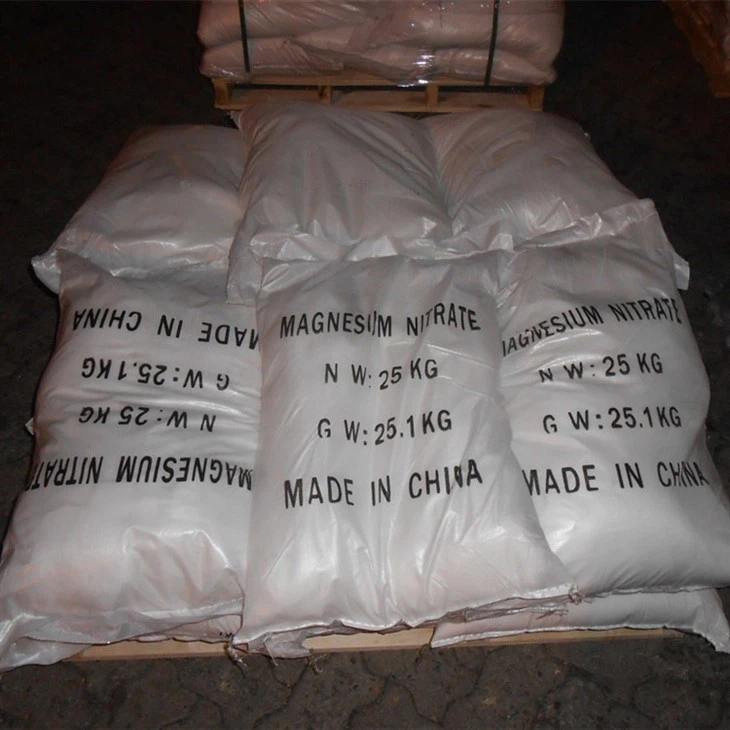
We offer high - quality magnesium nitrate in various forms and quantities. Our products are carefully tested to ensure they meet the highest standards of purity and quality. Whether you need a small sample for research or a large bulk order for industrial use, we've got you covered.
If you're thinking about using magnesium nitrate in your business or project, I encourage you to get in touch. We can discuss your specific requirements, answer any questions you might have, and provide you with a competitive quote. Whether it's for improving your crop yields, developing a new chemical product, or any other application, magnesium nitrate could be the solution you're looking for.
In conclusion, while magnesium nitrate doesn't have a traditional boiling point, its decomposition temperature of around 330°C is an important factor to consider when using it in high - temperature processes. Its unique properties and wide range of applications make it a valuable compound in many industries. So, if you're in the market for magnesium nitrate, don't hesitate to reach out. Let's work together to find the best solution for your needs.
References:

- General chemistry knowledge about magnesium nitrate properties and reactions.
- Information from reliable chemistry textbooks on nitrate decomposition.